


 By
By The more you can pull your own personality into your day-to-day marketing, communication and delivery of your work – the more you will be future-proofing your place in your work marketplace.
Why do I say that? There are few things that Artificial Intelligence can’t touch right now, and that’s your ability to:
- Feel and experience things (as a human and not as a data point)
- Know the context of what is going on in front of you, and
- Critically question the thinking behind different problems, challenges or solutions that are on the table.
What makes you the unique human you are – is what we need to double down on. So, in this post we are going to start with personality (which AI does not naturally have).
Personal brand implications in the modern workplace
With up to five different generations in the workplace today – there hasn’t been a more important time to emotively engage with your ideal clients, peers, senior leaders, colleagues or partners.
You and I both know, that people buy people, so human-focussed communication and marketing is the only way forward. This is why it’s worth doing some work on finding out how you come across to others and check-in on what their perception TRULY is of you.
Articulating your personality
Sounds weird – but bear with me. You’ve lived with yourself for decades and think you have this down pat. However – more often than not – many people haven’t really taken the time to think about this…from a 3rd party’s perspective.
As humans we are rife with our own head speak, beliefs and values that have driven us for years. No doubt it can all get a little mangled with the reality that others are experiencing of you.
When I work with clients on their personal brand strategy, we start with a simple step that answers these questions:
- How do you come across to people?
- What traits would they say are “definitely YOU”?
Once we nail this down – it helps to navigate how you’re thinking, acting and behaving. It also guides you on the kinds of words, phrases and emotive language to use to support bringing your personality to life at work.
Now, you will more than likely be already getting this right – intuitively – in your personal life, but may be holding back or flipping a switch when you are in “work mode”.
My wish for you is to be able to relax enough to be able to remove the switch and be more of yourself across the whole day and whole week.
Let me show you how. (Keep reading)
Codifying your personality
Let’s work on the assumption that you are a subject matter expert – someone who is proficient in their particular area of work and to whom others look to for advice, consultancy and guidance.
These are the kinds of individuals I tend to work most with – knowledge workers. Their value sits inherently within their knowledge, experience and expertise.
I use three dimensions to help clients nail down describing and articulating their personality, and then we work out how this ‘plays out’ in their day-to-day communication and interaction with others.
Dimension 1: Personality Traits
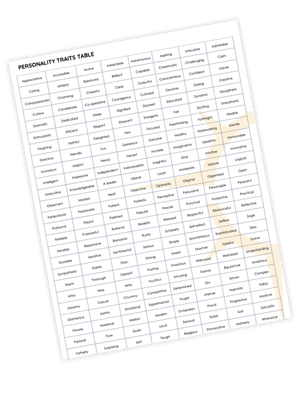
This is fairly simple. I have a table of 200 possible personality traits, and I get my client to work through it and circle any of the words they think they resonate most with. Then we whittle these down to 4 to 5 traits.
For each trait I get my client to describe why they resonate with it and what it means for them. This way I can work out if the word works and we can create a description that others will understand.
Dimension 2: Brand Archetypes
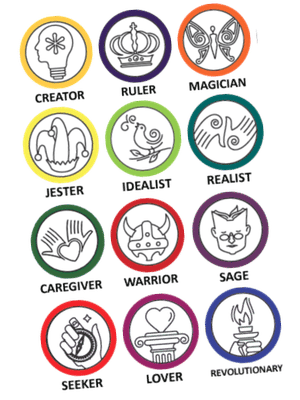 I use the original Pearson-Marr Brand Archetype Framework. This has twelve story-led archetype characters that help to pull out which characteristics are prevalent in you (as the professional doing the work you do).
This then helps us to reconcile this with the personality traits work from Dimension 1 above.
Your personality traits help to give you an internal way of choosing how you think, act and behave to the outside world.
Dimension 3: Tone of Voice
 This is the last element I look at to complete the work on articulating your personality for others.
You will have heard this term used a lot and particularly by communications consultants. Tone of voice is that subtle “between the lines” feeling you get when you read, listen or watch something. Like when someone is up on stage or on TV saying one thing, but their non-verbal cues and tone hits your gut and says it’s not ringing true.
I use a simple 4-quadrant grid to help pin point tone of voice based on these four points: FUN, EVERYDAY, SERIOUS and EXTREME. Once we work out where you are on the grid, we craft a short statement that describes your tone of voice nice and succinctly for you.
Importance of personality and tone – in your personal brand
I know it sounds simplistic, but just starting with the first step of being able to be honest and clearly describe how you want to come across to people (your personality and character) and being clear on your tone of voice helps massively.
It gives you an internal compass to ensure that you are being consistent and gives you a better chance of people having a good experience of you – regardless of how they interact with you.
It also goes a long way to building and retaining trust – which is a big factor with the clients I work with.
Want to work with me on articulating your personality?
What I’ve described above is step 1 of a 6 step framework I use in my personal brand work.
The other steps include:
- drawing out your back story (how you came to be here doing the work you’re doing)
- distilling your core values and converting these into your working principles
- identifying your strengths, expertise and unique talents
- defining why you are here, doing the work you are doing
- describing how you would like people to feel when they work with you (different to ‘perception’ which we handled above).
Book a no-obligation discovery call with me and we can walk through my framework together. I’d love you to share your objectives for wanting to do the work. (Pick a convenient time for our call here.)